
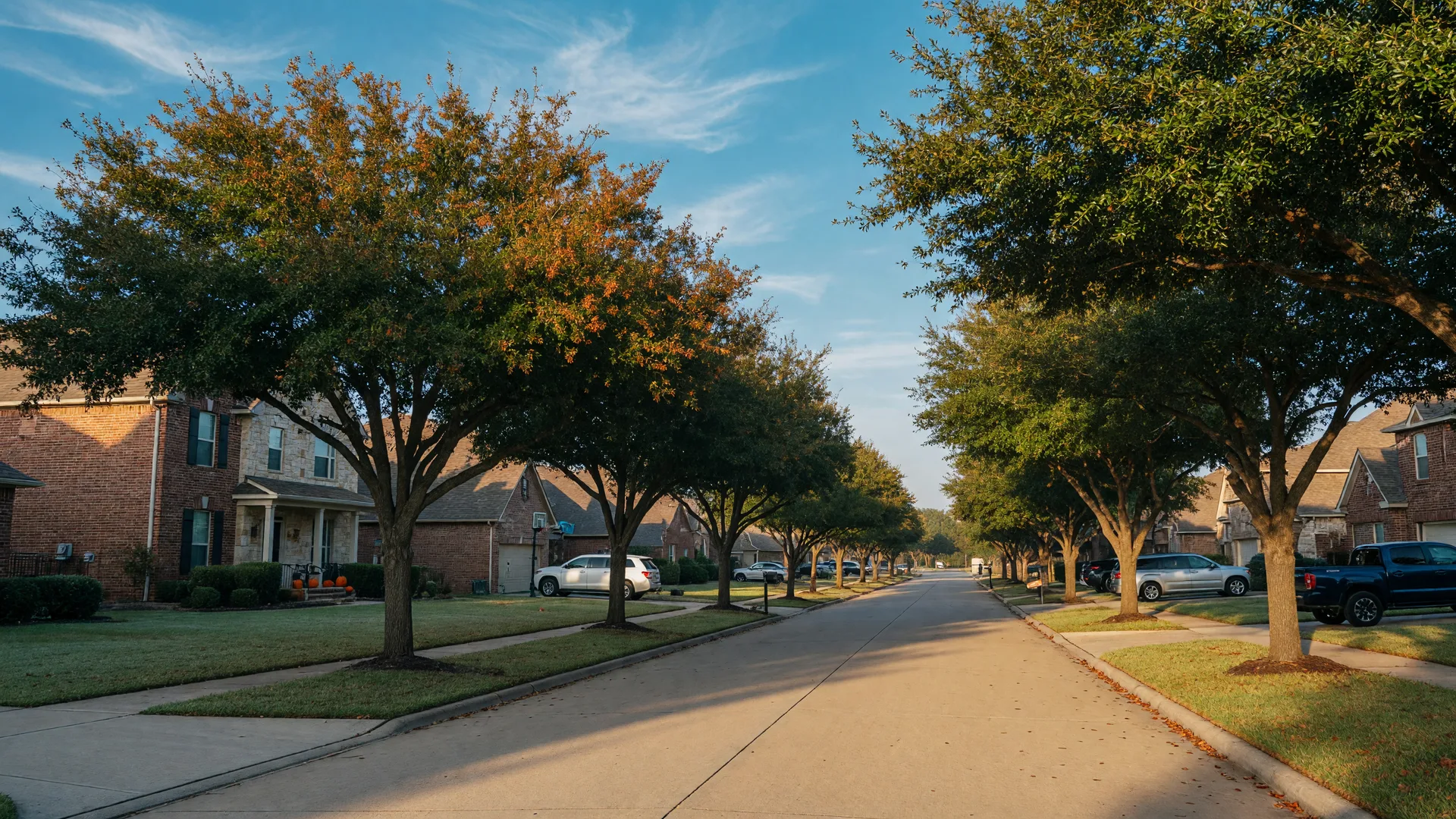
Moving to Katy, Texas from another state? The short version: Katy is a fast-growing suburb about 30 miles west of downtown Houston with one of the state's largest school districts, a deep job market anchored by the Energy Corridor, and a housing market that is more balanced than it has been in years. Roughly 556,000 people moved to Texas from another state in the latest Census migration data, and Katy is one of the places many of them land. This guide covers what actually matters when you relocate here: jobs, schools, housing costs, taxes, commutes, and the parts of the Texas buying process that surprise out-of-state buyers the most.
A quick note on geography before we start: "Katy" is two different things. The City of Katy is a small incorporated city of about 28,000 people, while Greater Katy, the continuous suburban area of master-planned communities around it, is home to roughly 340,000. When people say they are "moving to Katy," they almost always mean the larger area, which spans parts of Harris, Fort Bend, and Waller counties. That distinction matters for taxes, services, and which county you will deal with, and we come back to it below.
Why so many families are moving to Katy
Texas has been the country's biggest domestic-migration draw for years, and the latest Census Bureau data confirms it. In the 2024 American Community Survey state-to-state migration flows, released in January 2026, about 556,000 people moved to Texas from another state between 2023 and 2024, the largest inflow of any state. California sent the most newcomers, about 77,200, followed by Florida at roughly 52,200 and New York at about 28,200. Texas also posted the largest net domestic migration gain in the country, adding about 72,700 residents after accounting for people who left.
Katy's own growth tracks that story. The Census Bureau's July 1, 2025 estimate put the City of Katy at 28,373 residents, up about 29.7% from the 21,876 counted in the 2020 census. Across the wider Greater Katy area, the population is roughly 340,000 and still climbing, with master-planned communities opening new sections year after year. The reasons are consistent: jobs, schools, and a cost of living that compares well with the coastal metros people are leaving.
The job market: the Energy Corridor, Katy ISD, healthcare, and retail
Katy's biggest employment story sits right on its doorstep. The Energy Corridor, the business district along I-10 between Beltway 8 and the Grand Parkway, is Houston's second-largest employment center with roughly 91,000 to 94,000 workers, and it hosts the global or regional headquarters of major energy companies including Shell, bp, ConocoPhillips, Baker Hughes, Enbridge, and Fluor, plus non-energy names like Sysco and Gulf States Toyota.
Inside Greater Katy itself, the largest employer is Katy ISD with about 14,000 staff, followed by a mix of energy, healthcare, and retail: Academy Sports + Outdoors is headquartered here, Houston Methodist West Hospital and Memorial Hermann Katy Hospital anchor the healthcare side, Texas Children's Hospital has a West campus nearby, and Katy Mills and LaCenterra at Cinco Ranch are major retail and entertainment centers. For a suburb, the local job base is unusually deep, which is one reason so many families can live and work without ever commuting downtown.
Schools: Katy ISD is a big part of the draw
Katy ISD welcomed more than 97,000 students for the 2025-26 school year across more than 100 campuses and facilities, with about 14,000 educators and staff, and it opened two new elementary campuses that fall. It is one of the largest districts in Texas, and for many relocating families it is the single biggest reason Katy is on the list at all.
The honest caveat: a district that size is not one uniform experience. School zoning is by address, and feeder patterns differ across the district, so the elementary, middle, and high school assigned to a specific home can vary widely. If schools drive your move, look up the exact attendance zones for the homes you are considering before you tour. Our Katy community guide and the individual community pages below cover how the neighborhoods differ.
What housing costs in Katy right now
Katy's market is the most balanced it has been in years, which is good news for buyers who have time to look. In Houston Association of REALTORS data for July 2026, the Katy median sale price was about $385,000, with roughly four months of inventory, the neutral zone between a seller's and a buyer's market, and a median of about 30 days on market. Prices have flattened after the 2021-2023 run-up, and buyers have genuine choices again.
For a fuller picture of what that means for your budget, our Market Snapshot page tracks prices and inventory month by month, and the 2026 market outlook post walks through the affordability math in detail. When you are ready to look at specific homes, the Katy homes guide is the place to start.
Property taxes: the trade-off for having no state income tax
Texas has no state income tax, and that is a real advantage for many movers, but the trade-off is that property taxes carry more of the load. Katy ISD's rate for FY 2026-27 is $1.1171 per $100 of assessed value, with county, city, and utility district layers on top depending on exactly where you buy. Two similar homes a few miles apart can have meaningfully different bills, because "Katy" spans three counties and a mix of city limits, unincorporated areas, and municipal utility districts.
The good news is that Texas pairs those rates with strong homeowner protections: the residence homestead exemption now stands at $140,000 for school taxes, and the appraisal cap limits how fast your assessed value can climb, to 10% a year once your homestead is on file. Our property tax guide breaks down every layer with current rates, and it is worth reading before you compare neighborhoods, because the tax line is part of the real monthly cost of any home.
The commute: I-10, the Grand Parkway, and the Energy Corridor
Katy sits about 30 miles west of downtown Houston, connected by I-10, the Katy Freeway. In practice, commute times split by destination. The Energy Corridor, about 13 miles from most Katy neighborhoods, runs roughly 17 to 20 minutes off-peak and 22 to 35 minutes in typical peak traffic. Downtown Houston, about 30 miles, runs 30 to 35 minutes off-peak and 40 to 55 minutes in the rush. The Grand Parkway (SH 99) and the Westpark Tollway give you east-west and north-south alternatives, and METRO park-and-ride lots serve commuters heading into the city.
If the commute matters to you, which Katy neighborhood you pick changes the answer, so it is worth testing the drive from a few candidate areas at the times you would actually travel before you commit to one.
How the Texas buying process differs for out-of-state buyers
If you have bought a home in another state, expect a few Texas-specific steps. The option period is the big one: in most Texas contracts, the buyer pays a small option fee for a set number of days, typically 7 to 10, during which they can terminate the contract for any reason. That window is when inspections happen. Sellers must complete a Seller's Disclosure Notice covering known defects, and the seller pays for the owner's title policy, which is unusual compared with many other states. Closings are handled by title companies, and attorneys are not required in the standard transaction.
For a step-by-step walkthrough of the whole process, the Buy a Home section covers everything from pre-approval to closing, and we are happy to walk you through the differences for your specific situation. One practical note for out-of-state buyers: if you are moving for a job, talk to your lender about timing early, because the appraisal and underwriting steps are the ones that slip schedules, not the inspection.
Neighborhoods worth a look
Greater Katy is really a collection of distinct communities, and the right one depends on your commute, school priorities, and budget. Cinco Ranch is the area's best-known master-planned community, with pools, trails, and a long list of amenities. Fulshear, to the southwest, has been one of the fastest-growing areas in the region. Cypress, to the north, offers newer construction and its own school options. West Houston covers the older, established suburbs closest to the Energy Corridor. Start with the community guides, then tell us which ones fit your list and we will pull the current numbers for each.
A note on the numbers
Population figures come from the U.S. Census Bureau's July 1, 2025 city estimates and the 2024 American Community Survey state-to-state migration flows, released January 2026. Katy ISD enrollment is the district's official 2025-26 first-day count. Employment figures come from the Katy Area Economic Development Council and the Energy Corridor District. Market figures are Houston Association of REALTORS data for July 2026, and commute estimates are typical published ranges for the I-10 corridor. All of these change over time, so treat them as a snapshot and verify what matters most to you before you commit.
Planning a move to Katy? Let's map it out together.
A relocation is a lot of moving parts: neighborhoods, schools, commute times, taxes, and the timing of the move itself. You do not have to figure it out from another state. Tell us where you are coming from and what you are looking for, and Carol will walk you through the areas that fit, the current market for your budget, and a realistic timeline. Call her at (832) 212-2772 or send a note through the contact page, and we will get you the neighborhood-level numbers you need to make the move with confidence.